


Category: Exhibition & Production Management
Event Production Services Explained: What Happens Behind Every Successful Event?
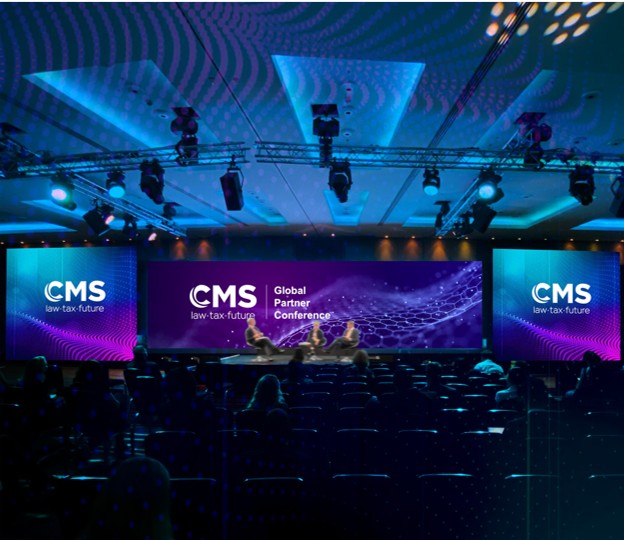
When people remember a corporate event, they rarely think about the lighting cues, stage transitions, or technical rehearsals that made it all possible. They remember how it made them feel. A keynote that held their attention. A product launch that built genuine excitement. An awards evening that felt seamless from start to finish.
Those experiences do not happen by chance. They are the result of professional event production services working behind the scenes to transform an event concept into a polished, engaging experience.
The stakes are significant, as delegates now expect in-person corporate events to incorporate modern production technology as a baseline expectation of professionalism. When event production services fall short of that standard, audiences notice immediately, even when they cannot quite name why.
Let’s understand what event production covers, how it differs from event planning, and what to look for when choosing the right event design and production company for your next corporate event.
What Are Event Production Services?
Event production services encompass the full technical and creative delivery of a live event, everything the audience sees, hears, and feels from the moment they enter the room.
While event planning focuses on objectives, budgets, and logistics, production is responsible for creating the environment, atmosphere, and audience experience that supports those goals.
A professional production team manages everything required to deliver a seamless live event: creative design, staging, audiovisual technology, technical rehearsals, live streaming, and on-site show management.
For businesses, effective event production goes beyond impressive visuals. It creates moments that engage audiences, reinforce brand identity, and help organisations communicate with impact- the kind of impact that is still being discussed long after the event ends.
What Happens Behind Every Successful Event?
The most memorable corporate events are built through detailed planning, technical expertise, and creative collaboration long before the first delegate arrives. Each element of production plays a distinct role in shaping what the audience ultimately experiences.
1. Creative Event Design
Every production begins with a creative concept, the visual identity that gives an event its character and strategic purpose. Production teams develop concepts that reflect the event’s objectives, audience, and brand identity, shaping everything from room layouts and stage design to content, graphics, and delegate flow.
Creative direction matters because it determines whether an event feels coherent or cobbled together. When the environment, content, and brand narrative align, delegates absorb the message without consciously realising it. Attention is higher, recall is stronger, and brand perception shifts in the intended direction.
At SEVEN, our creative studio develops this direction from the initial brief, ensuring the creative concept and the production plan are built as one rather than handed between separate teams.
For experiential event production, creative design goes further still, building environments that invite participation rather than passive observation:
- Multi-zone spaces where delegates move between areas with distinct atmospheres
- Interactive installations that create genuine moments of discovery
- Sensory journeys where sound, lighting, and spatial design combine into a coherent emotional arc
A strong example of this approach was our activation for TravelUp’s “Up Yours” campaign.
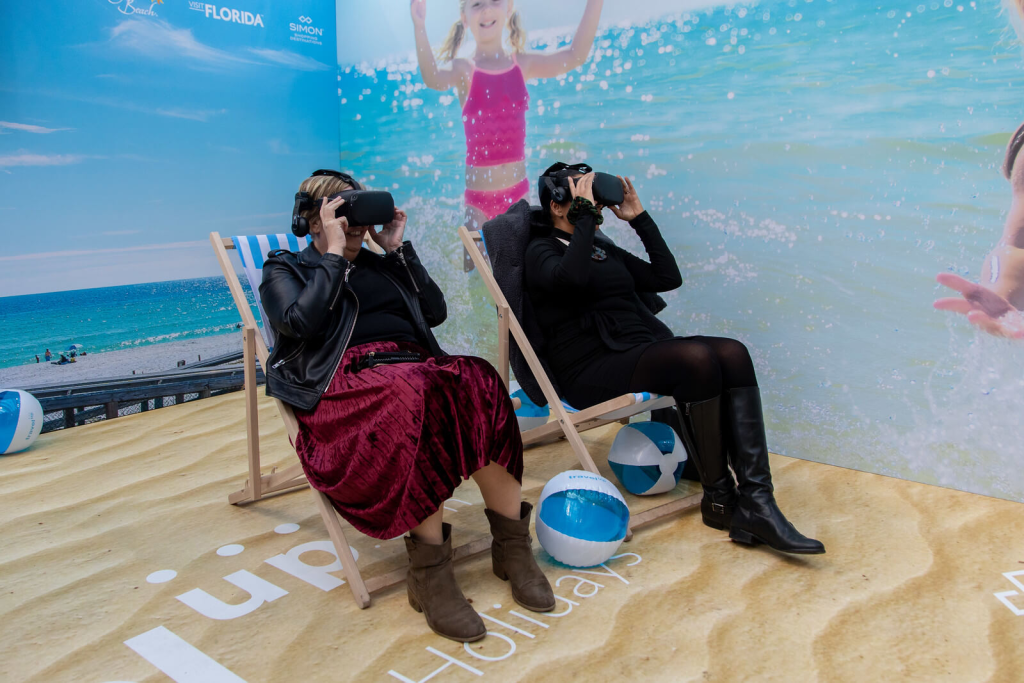
We transformed London’s Waterloo Station into an immersive Florida-inspired destination, giving commuters the chance to escape the winter commute through an interactive virtual reality experience.
Bespoke scenic elements, tropical beach styling, branded graphics, realistic flooring, and ambient heating worked together to recreate the warmth and atmosphere of the Sunshine State.
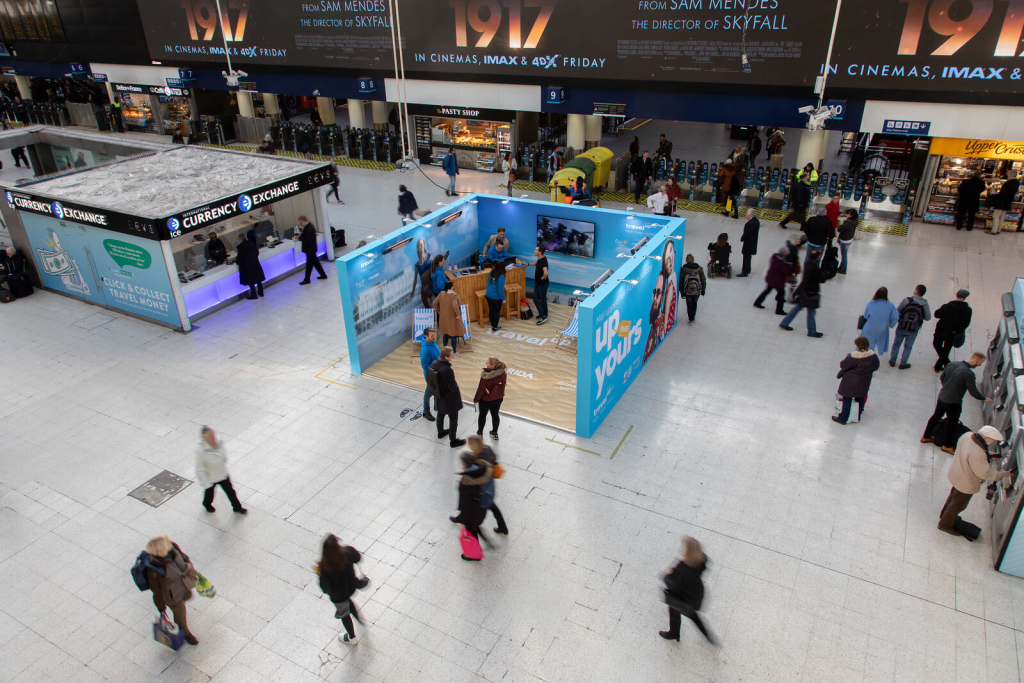
Rather than simply promoting a holiday destination, the activation immersed people in the experience, creating an emotional connection that encouraged them to imagine themselves there before they had even booked a trip.
Experiential design is one of the defining shifts in corporate events, with immersive staging and spatial flow now treated as strategic tools rather than aesthetic choices.
Activations like the TravelUp campaign demonstrate how thoughtful creative direction can transform an everyday space into a memorable brand experience that captures attention, encourages participation, and leaves a lasting impression.
2. Stage, Set and Scenic Production
The physical environment has a significant influence on how audiences experience an event. Stage layouts, scenic elements, branding, and production design work together to create the right atmosphere while supporting presenters and performers throughout the programme.
The reason stage design matters beyond aesthetics is authority and credibility. A well-designed fabrication signals to the audience that the organisation behind the event takes the occasion seriously, before a speaker has said a word, the room has already formed an impression. A generic stage in a generic room communicates the opposite. For experiential event production, the stage or fabrication becomes part of the narrative itself: curved LED walls, multi-level set pieces, and integrated content screens transform a presentation into something the audience physically feels rather than merely watches.
Technical planning also covers production schedules, equipment logistics, supplier coordination, and installation, ensuring every element is in place and tested well before delegates arrive.
3. Lighting, Audio, Visual Technology and Hybrid Production
AV and technical production is the most consequential element of the on-day experience. Poor audio is the single most common reason delegates disengage.
When the sound quality is poor, authority drains from the speaker, and attention follows. Poor lighting makes content difficult to read and stages hard to see from the back of a large room.
A professional production team selects and operates every technical element calibrated to the specific venue, room acoustics, and content requirements:
- LED video walls and projection mapping that ensure visual content lands with impact
- Broadcast-quality sound systems matched to the room’s acoustic profile
- Live streaming infrastructure for remote or international audiences
Hybrid production is now a core expectation rather than an optional extra. Event organisers now plan to include a virtual component at their next in-person event — making hybrid capability a standard feature of any professional production offer, not a specialist add-on.
4. Technical Rehearsals and Show Calling
What separates professional event production services from basic AV hire is what happens before the audience arrives.
Technical rehearsals allow every element, audio cues, video playback, lighting states, speaker run-throughs, and transition timings to be tested and locked before the event goes live. The value is not just error prevention.
Rehearsals give speakers confidence, sharpen timing, and surface any mismatch between the creative vision and the technical reality while there is still time to resolve it.
Show calling is the discipline of running those elements in real time on the day. A dedicated operator cues every technical moment to the second, keeping the event on schedule, and resolving anything unexpected before the audience notices.
It is invisible when done well. It is conspicuous and costly when absent.
Event Production vs Event Planning: What’s the Difference?
Although the terms are often used interchangeably, event planning and event production perform different but complementary roles.
Understanding the distinction helps buyers resource events correctly and avoid the common mistake of treating production as an afterthought once all planning decisions have been made.
| Event Planning | Event Production | |
| Focus | Strategy, logistics, delegate experience | Technical and creative delivery |
| Covers | Objectives, venue, suppliers, budget, communications | AV, staging, lighting, content, crew |
| Timing | Begins months before the event | Intensifies in weeks before and on the day |
| Output | A well-organised event | A well-executed, impactful experience |
| Delivered by | Event manager or agency | Production company or in-house studio |
The strongest corporate events bring planning and production together from the brief stage, not as a handover at the end, but as two disciplines informing each other throughout.
When creative, production, and event management teams are integrated under one roof, briefing gaps close, decision-making accelerates, and the event that reaches the audience is the event that was originally conceived.
What to Look for in an Event Design and Production Company?
The quality of your event design and production company determines the quality of everything your audience experiences. When evaluating a production partner, the questions that matter most are:
- In-house creative capability: do they design in-house or outsource to third parties? In-house means faster iteration, stronger creative coherence, and a single point of accountability from concept to execution.
- Relevant experience: can they demonstrate comparable events at a similar scale and with a similar level of venue complexity to yours?
- Hybrid and live streaming: is this a core service with dedicated technical infrastructure, or a bolt-on capability?
- Rehearsal and show-calling process: how do they manage technical preparation, and who calls the show on the day?
- Integrated planning and production: do they work collaboratively with your event management team from the outset, or do they step in at the end?
- Post-event content capture: do they produce footage and photography to extend the event’s value beyond the room?
These criteria matter because the difference between a good production company and a great one is process, accountability, and the ability to translate a brand story into a live experience that audiences remember.
At SEVEN Events, our in-house creative studio handles every layer of production, from initial concept and scenic design through to technical direction and post-event content capture. Our integrated approach means planning, creativity, and production are developed together from day one, not handed between separate teams.
Working across 85+ countries since 2009, we have delivered production management and exhibition design for clients including Telefónica Tech, Just Eat, and Sophos, events where production was not a support function but the central reason the experience worked. Speak to our team about your next event.
SEVEN’s Insight
Exceptional corporate events are never the result of technology alone. They are built through thoughtful creative direction, meticulous preparation, and professional event production services that reliably bring every idea to life on the day, in front of an attentive audience.
For any corporate event where audience experience matters, where the brand is on show, or where the business needs measurable impact, experiential event production is not an optional upgrade. It is the infrastructure every other investment depends on. Get it right, and delegates carry the experience with them long after the room has emptied.
FAQs
What are event production services?
Event production services cover the full technical and creative delivery of a live event, stage design, lighting, audio, visual technology, live streaming, content playback, technical direction, and on-site crew management. Together they determine the quality of everything the audience sees, hears, and experiences on the day.
What is included in event production?
A full production service typically includes creative set and scenic design, AV specification and operation, lighting design, live streaming and hybrid production, pre-event technical rehearsals, show calling on the day, and post-event content capture.
What is the difference between event planning and event production?
Event planning covers strategy, logistics, and supplier management. Event production covers the technical and creative delivery, the AV, staging, lighting, and content that determines the quality of the audience experience. The strongest events integrate both disciplines from the brief stage.
Exhibitions Taking Place this Summer
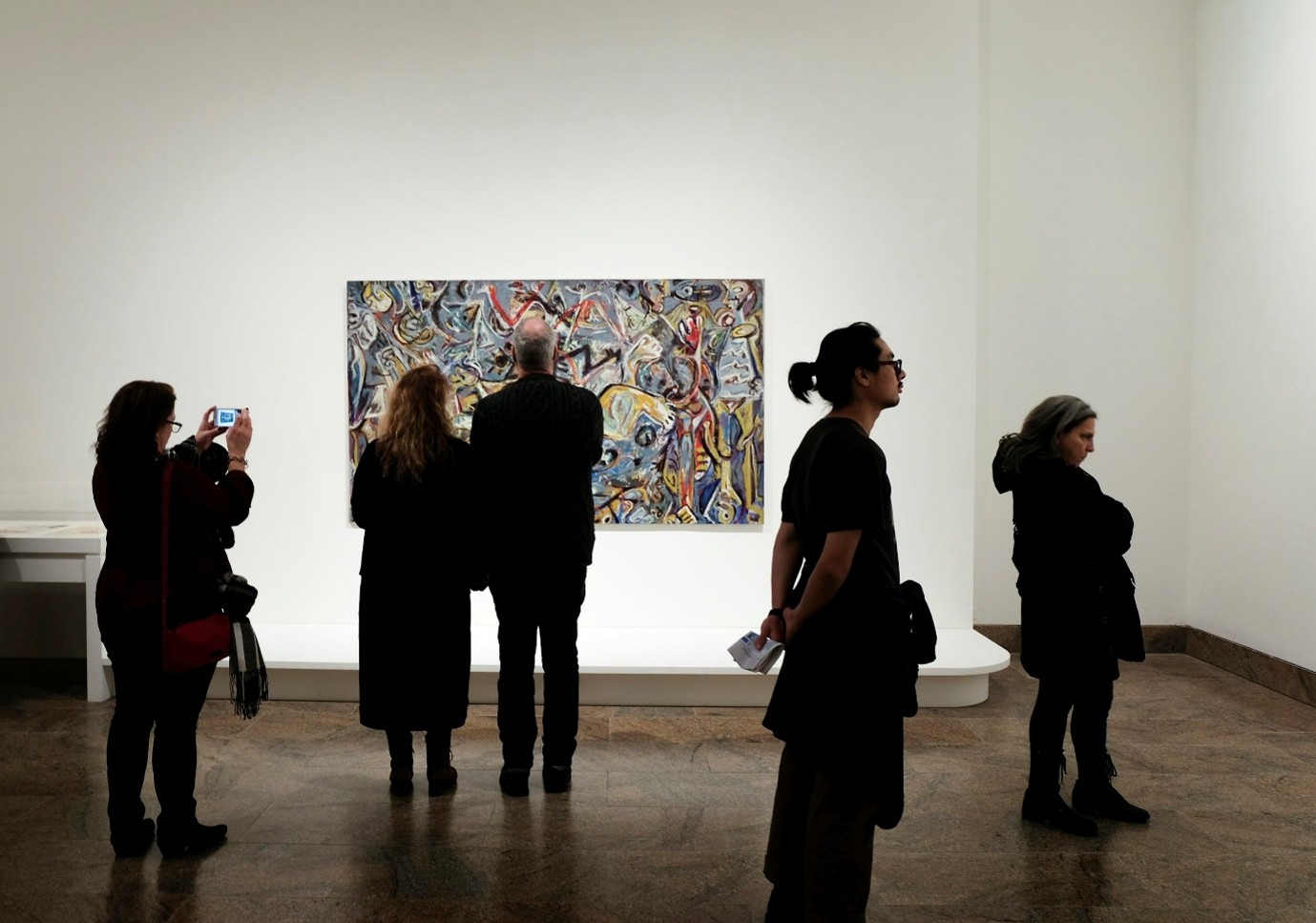
In Other Worlds
At the heart of the season is In Other Worlds, an immersive exhibition by filmmaker and speculative architect Liam Young, taking place in The Barbican. This is his first major solo exhibition and one to definitely go and visit. Through cinematic installations, soundscapes, costumes, and imagined climate futures, the exhibition explores what humanity’s next chapter could look like. Rather than dystopian collapse, Young presents radically optimistic visions rooted in real technological possibilities.
Dates: 21st May to 2026 to Sunday 6th September 2026
Tate Modern Continues Its International Focus
Across the Thames, Tate Modern is continuing its run of internationally focused exhibitions with a major retrospective dedicated to kinetic and Op artist Julio Le Parc. Renowned for his immersive investigations of movement, light, mirrors, and audience participation, Le Parc’s work invites visitors to become part of the experience rather than simply observe it. Featuring suspended installations and dynamic optical environments, the exhibition promises to be one of the summer’s most visually captivating shows.
Dates: 11th June 2026 – 3 May 2027
James McNeill Whistler at The Tate
While Tate Modern looks outward and experimental, Tate Britain is turning its attention to one of the artists who helped define London visually: James McNeill Whistler. The exhibition explores Whistler’s enduring fascination with the River Thames and the industrial landscape of nineteenth-century London, bringing together his atmospheric “Nocturnes” with etchings, portraits, and seldom-displayed works. Critics have commended the show for evoking both the dynamism and underlying melancholy of a city undergoing rapid modern transformation.
Dates: Till 27th September 2026
Rising Voices: Contemporary Art from Asia, Australia and the Pacific
A landmark collaboration between the V&A and the Queensland Art Gallery | Gallery of Modern Art (QAGOMA), Brisbane.
At the V&A this summer the standout exhibition is Rising Voices. Created in partnership with Queensland Art Gallery’s Asia Pacific Triennial, the exhibition brings together more than 70 works by artists from 25 countries, forming one of the UK’s most significant recent presentations of contemporary Asia-Pacific art. The exhibition navigates themes of politics, spirituality, colonial legacies, and material innovation with remarkable fluidity. It also signals a wider shift across London’s cultural institutions toward more global perspectives that question and expand beyond traditional Eurocentric art histories.
Dates: till 10th January 2027
Have you thought about hosting an event in an exhibition space?
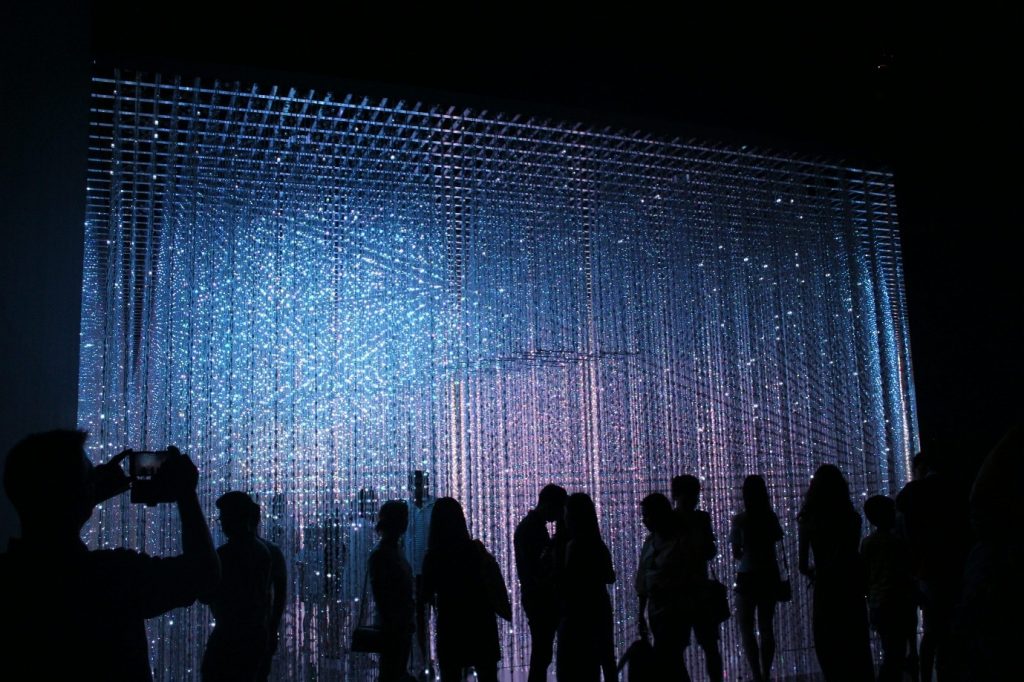
Exhibitions offer far more than just a cultural experience, they create a dynamic and visually engaging setting for events that naturally attracts people in. Hosting an event within an exhibition space allows guests to immerse themselves in art, design, or storytelling while networking, socialising, or celebrating, making the occasion feel far more memorable than a traditional venue. Whether it’s a product launch, corporate gathering, private reception, or brand activation, exhibitions provide built-in atmosphere, conversation starters, and a sense of exclusivity that encourages attendance and engagement. By combining entertainment with experience, exhibition events draw audiences who are looking for something interactive, inspiring, and shareable, helping organisers create buzz both in person and across social media.
At SEVEN, we provide end-to-end support including creative development, logistics management, venue sourcing, production and on-site event delivery to ensure a seamless experience across every location. Get in touch with us to start the conversation.
Event Production vs Event Management: Key Differences Explained
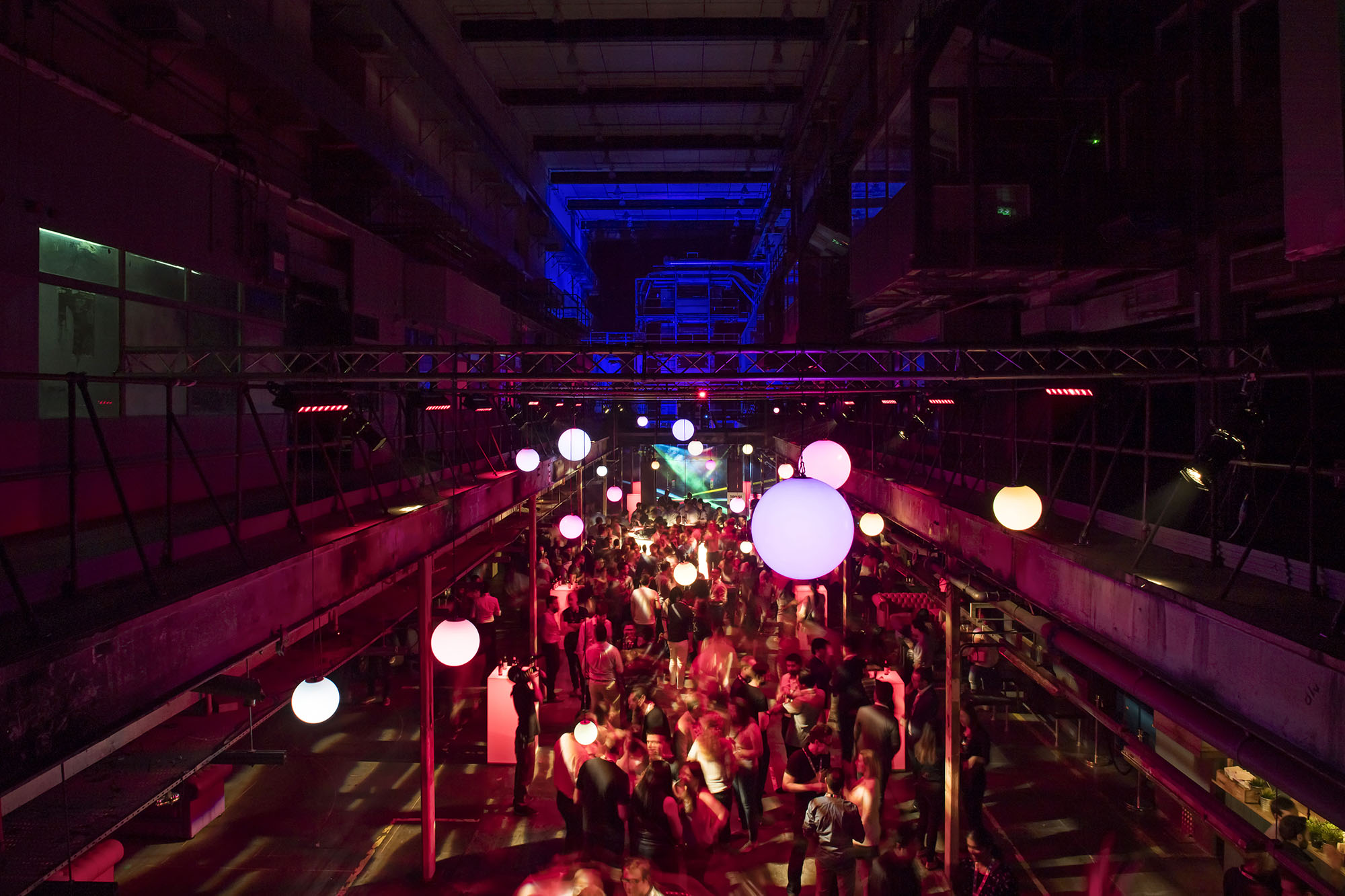
Businesses planning a large-scale conference, product launch, or brand experience often discover mid-planning that they’ve conflated two distinct disciplines: event production and event management.
The confusion is understandable. Both are present at every well-run event. Both matter. But they do fundamentally different things, and knowing which one you need, and when, is the difference between a well-planned event and one that actually works.
Today, we break down what each discipline covers, where they overlap, and why the most successful events treat them as complementary rather than interchangeable.
What Is Event Management?
Event management is the planning and coordination function of any event. It’s the discipline that takes a brief and builds the operational structure that makes an event possible. In practice, event management covers:
- Budget planning and financial oversight – setting the budget, tracking spend, and managing cost control across every workstream.
- Scheduling and timeline management – building and maintaining the project plan from the first kick-off call through to post-event review.
- Vendor coordination – identifying, briefing, and managing every supplier involved in the event.
- Logistics management – venue contracting, delegate travel, accommodation, catering, and on-site operations.
- Client and supplier communication – keeping all parties informed and in agreement across the planning process and responding to changes as they arise.
Event management is the discipline that stops things falling through the gaps. It’s what makes a complex event with dozens of moving parts feel, from the outside, like it ran effortlessly. The planning is invisible when it’s done well, and painfully visible when it isn’t.
What Is Event Production?
Event production is the technical and creative execution of an event. While event management builds the plan, production brings it to life physically, visually, and sonically.
Production management services cover:
- Audio-visual design and operation – sound systems, screens, video playback, and live switching throughout the event.
- Lighting design and rigging – the creative and technical work that shapes how a space looks and how attention is directed within it.
- Stage design and set build – from a simple conference set to a fully built exhibition environment.
- Fabrication and installation – the physical construction of branded elements, structures, and bespoke set pieces.
- On-site technical management – a production crew and technical director present throughout, managing everything from the control desk to the stage floor.
A well-run event production function is the reason a keynote speaker sounds clear to every person in a 500-seat auditorium.
It’s why the LED wall behind the stage displays the right content at the right moment. It’s the technical precision that makes a creative concept land.
At SEVEN, production management services sit alongside event management as an integrated offering, not a bolt-on. That distinction matters when you’re planning anything beyond a basic meeting format.
What Are Production Design Services?
Production design services sit at the intersection of creative direction and technical planning. This is the discipline that takes a brand or event concept and translates it into a physical, spatial, and visual language.
Production design services typically cover:
- Stage design – the visual architecture of the main presentation space, including set elements, scenic structure, and sight lines from the audience.
- Set creation and fabrication – the physical build of bespoke elements that can’t be hired off a shelf.
- Visual storytelling – working with video content, motion graphics, lighting states, and environmental design to tell a coherent story across the full event space.
- Technical layouts and production drawings – the detailed specifications that allow the build team to execute the design accurately within the venue’s constraints.
Production design services are what separate an event that looks generic from one that looks like it was made specifically for the brand running it.
Every element, the colour temperature of the lighting, the depth of the stage, the proportion of the set against the room, has been considered in relation to the brand, the content, and the audience.
At SEVEN, production design begins at the briefing stage, not after the event management plan has been signed off. That allows the creative and operational workstreams to inform each other rather than running in sequence.
Key Differences Between Event Production and Event Management
The clearest way to understand the distinction is to follow what each discipline owns across the event lifecycle.
| Aspect | Event Management | Event Production | How They Work Together |
| Primary Focus | Oversees the overall planning and coordination of the event | Oversees the technical and creative execution of the live experience | Both functions collaborate to deliver a seamless event from planning to execution |
| Core Questions Owned | “What, when, who, and how much” | “How it looks, sounds, and feels” | Decisions in one area directly impact the other |
| Main Responsibility | Managing the event plan, timeline, budget, and stakeholders | Managing staging, lighting, sound, visuals, and technical delivery | Constant communication ensures alignment between logistics and technical execution |
| Key Objective | Ensure every element is organised before the event begins | Ensure the audience experience matches the creative vision without technical failures | Both aim to create a successful and engaging event experience |
| Typical Tasks | Scheduling, vendor coordination, budgeting, guest management, venue logistics, staffing, and run-of-show planning | Audio-visual setup, stage production, lighting design, live streaming, cue management, technical rehearsals, and equipment oversight | Shared updates help avoid delays, technical issues, and scheduling conflicts |
| Role During Event Day | Keeps the event running on time and coordinates all moving parts | Executes live technical cues and manages production performance | Both teams work in lockstep during live execution |
| Impact of Changes | Adjusts timelines, schedules, staffing, and coordination plans | Adjusts cue lists, technical timing, production flow, and equipment requirements | Even small run-of-show changes affect both teams simultaneously |
| Success Measurement | Smooth logistics, efficient coordination, budget control, and stakeholder satisfaction | Flawless technical delivery, immersive audience experience, and creative consistency | Success depends on both operational precision and technical excellence |
| Example Role Titles | Event Manager, Event Coordinator, Project Manager | Production Manager, Technical Director, Stage Manager | Leadership teams often collaborate on the same event brief |
| Relationship Between Teams | Provides structure and operational direction | Brings the event vision to life technically and creatively | Agencies like SEVEN integrate both functions closely, so teams solve the same problem from different angles |
When Do You Need Production Management Services?
Production management services become necessary as soon as an event involves any significant technical element. The threshold is lower than most clients expect.
A conference for 100 people with a live presentation, a screen, and a microphone already involves production. The question is whether that production is being managed professionally or is being left to whoever shows up and hopes the HDMI cable works.
Production management services are non-negotiable for:
- Large-scale conferences and summits – where AV failure or technical instability during a keynote is not a recoverable situation.
- Exhibitions and expos – where stand design, lighting, and interactive technology all require coordinated build and operation.
- Product launches – where the production quality has a direct relationship with how the product is perceived.
- Experiential marketing installations – where the entire concept depends on technical execution.
- Hybrid events – where the online experience requires broadcast-quality production to hold a remote audience.
If the audience will notice when something goes wrong, you need dedicated production management services in place before the event begins.
When Do You Need Production Design Services?
Production design services are the right call any time an event needs to look and feel like something specific, not just functional.
If your brief includes phrases like “we want it to feel like a brand world,” “we want the audience to feel a certain way when they walk in,” or “this needs to be different from what we’ve done before,” that’s a production design brief.
The answer to those briefs isn’t better logistics – it’s creative direction applied to space, light, structure, and content.
Production design services are particularly valuable for:
- Annual conferences that need to evolve year-on-year without losing their identity.
- Leadership summits where the environment needs to reflect the seniority and ambition of the audience.
- Awards ceremonies where the staging has to carry both gravitas and celebration.
- Experiential activations where the design is the product.
The earlier production design services are brought into a project, the more coherent the result. Design decisions made after the logistics are locked tend to be constrained by what’s already been agreed. Design decisions made alongside the logistics shape the event from the ground up.
When Do You Need Both?
For most serious corporate events, both disciplines are present. The question is whether both are being handled with equal rigour.
The most common failure mode is an event that’s well-managed but poorly produced. The logistics worked, the catering arrived on time, the delegates were registered correctly, but the main stage looked flat, the sound was uneven, and the experience didn’t match the ambition of the brief.
The second most common failure mode is an event that’s beautifully designed but under-managed: the set looks incredible, the production team did excellent work, but the run of show slipped, a speaker arrived late because travel wasn’t coordinated, and the catering ran out an hour before the end.
Both functions need to be present, briefed from the same starting point, and communicating throughout. At SEVEN, production management services and production design services sit within the same agency structure as event management, so none of the coordination that matters falls between disciplines.
How Does This Connect to Exhibition Strategy?
Exhibitions make the relationship between event management and production particularly clear.
The event management function handles venue contracting, build schedules, contractor coordination, and on-site logistics.
The production function handles stand design, fabrication, technical installation, and the on-site experience.
Neither works without the other. A beautifully designed stand that isn’t installed correctly, or isn’t ready when the doors open, fails commercially regardless of the creative quality.
A logistically precise exhibition that looks generic fails commercially regardless of how well the budget was managed.
For a complete guide to combining design and production for exhibitions, read our Exhibition Stand Design guide.
Why Work With SEVEN?
SEVEN provides event management, production management services, and production design services as a single, integrated offering. That means one agency, one brief, and one team accountable for both the plan and its execution.
Our clients include global brands in technology, finance, healthcare, and automotive, running events across more than 85 countries.
Whether you need a fully produced annual conference, an experiential brand activation, or an exhibition stand that performs commercially, we’d love to hear from you.
Connect with the team at SEVEN.
FAQs
1. What is event production?
Event production is the technical and creative execution of a live event, covering AV, lighting, staging, fabrication, and on-site technical management.
2. What is the difference between event production and event management?
Event management plans and coordinates the event. Event production executes it technically and creatively. Both are needed for high-quality events.
3. What are production design services?
Production design covers the creative translation of a brief into a physical event environment, including stage design, set build, visual storytelling, and technical layout.
Exhibition Stand Design & Event Production: Complete Guide for Brands
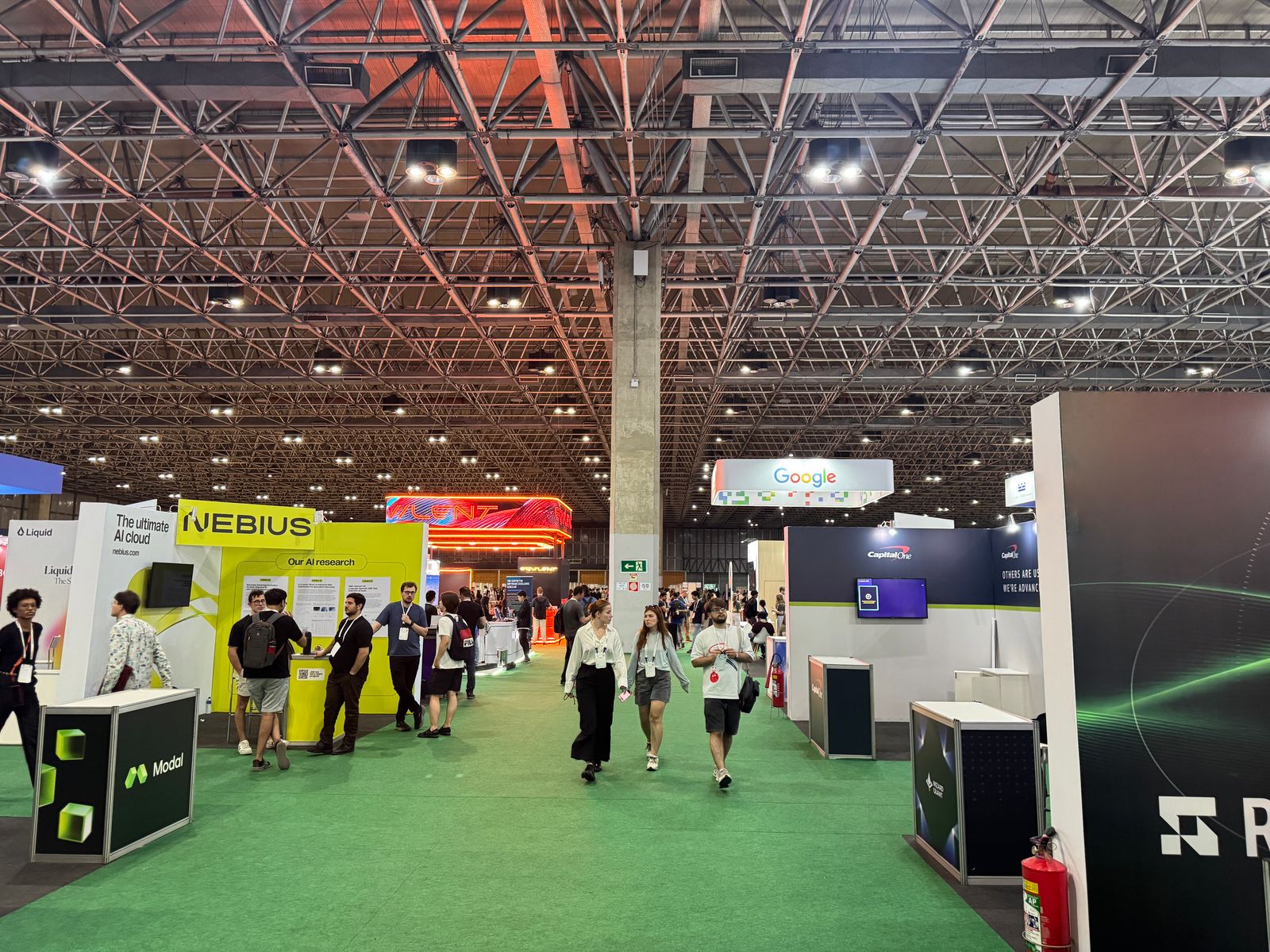
Exhibitions and trade shows give brands direct, physical access to an engaged audience. When someone walks into your stand, they’ve already chosen to stop.
The question is what happens next, and that depends almost entirely on how well the space was designed and how professionally the production was executed.
Today, we will cover everything UK brands need to know about exhibition stand design and event production services, from initial planning through to on-site delivery and beyond.
What Is Exhibition Stand Design?
Exhibition stand design is the discipline of creating a branded physical space that attracts visitors, holds their attention, and moves them towards a clear outcome, whether that’s a conversation, a product demo, a data capture, or a brand impression that sticks.
Good stand design starts well before anyone picks up a drill. It begins with questions:
- Who is the audience?
- What do we want them to feel when they arrive?
- What’s the journey from the aisle to the back of the stand?
- What’s the single most important message this space needs to communicate?
The physical elements that follow, layout, branding, signage, furniture, interactive technology, and lighting, are all answers to those questions. Working with a specialist in exhibition stand design means those answers are coherent, purposeful, and built to perform rather than just look impressive in a render.
At SEVEN, stand design is never treated as a visual exercise in isolation. It’s a strategic one. Every spatial decision we make is connected to your brief, your audience, and the commercial outcome you’re trying to achieve.
What Are Event Production Services?
Event production services cover the technical and operational side of bringing an event or exhibition to life. This is the layer of expertise that sits beneath the creative concept and makes sure it actually works when the doors open.
At a practical level, that includes:
- Lighting design and installation – the difference between a stand that commands attention from twenty metres away and one that disappears into the background.
- AV setup and management – screens, sound systems, video content playback, and any live broadcast or streaming requirements.
- Stage and set design – for brands running theatre-style presentations or keynote moments within their exhibition footprint.
- Fabrication and installation – the physical build, from structural elements and branded walls through to bespoke furniture and signage.
- On-site technical management – a production team on the ground throughout the event, ready to manage anything that needs adjusting in real time.
A professional event production agency in London brings all of these capabilities together under one roof. That matters because it removes the coordination burden from your team and puts a single, experienced point of accountability in its place.
Why Exhibition Stand Design and Event Production Must Work Together?
You can have a beautiful stand that nobody remembers, and you can have a technically flawless production that fails to land because the creative concept was weak. The two disciplines need each other.
When exhibition stand design and event production services are planned as one integrated process, the results are categorically different. The lighting is designed to work with the colour palette.
The AV content is sized for the screens that were specified. The visitor flow through the space is mapped before the build begins. The brand story runs consistently from the first visual impression to the last conversation.
At SEVEN, our in-house creative and production teams work from the same brief. That means the people designing your stand and the people building it are in the same conversations from day one. No handoff problems. No late-stage surprises when the design meets the reality of the venue.
What Are The Key Elements of High-Impact Exhibition Stands?
1. Strategic Layout and Flow
The layout of your stand determines the quality of the conversations you have. A poorly designed space creates bottlenecks, dead ends, and zones that visitors avoid entirely.
A well-designed one pulls people through naturally, creating the right moments for engagement along the way.
Think about entry points, sightlines from the aisle, areas for private conversations, and how visitors move from initial interest to a direct interaction with your team. These aren’t aesthetic choices, they’re commercial ones.
2. Strong Visual Identity
Your stand needs to be recognisably yours within seconds. That means consistent application of your brand, colour, typography, tone, across every physical element.
It also means making one clear visual decision that anchors the whole space rather than letting competing elements pull in different directions.
The brands that stand out on a busy exhibition floor are rarely the ones with the most going on. They’re the ones with the clearest single message and the confidence to commit to it.
3. Interactive Experiences
Passive stands lose visitors fast. Any element that invites participation, a product demo, a touchscreen, a VR experience, or a live presentation, raises dwell time and gives your team a natural reason to start conversations.
The technology should serve the objective, not the other way round. A well-chosen interactive element draws people in and gives them something to talk about. A poorly chosen one creates queues and confusion.
4. Technical Excellence
Lighting, sound, and digital integration all need to perform reliably across the full duration of the event. A screen that freezes, a microphone that cuts out, or lighting that hasn’t been set up for the venue’s conditions can undermine a stand that looks perfect in every other respect.
This is where experienced event production services pay for themselves. Getting the technical layer right is what allows everything else to work.
Types of Exhibition and Expo Projects
Brands approach SEVEN for very different kinds of exhibition and experiential work. The common thread is the need for design and production to work together at a high level of quality.
- Trade shows are the most familiar format, a branded stand within a larger event, competing for attention from a shared visitor pool. The brief here is almost always visibility, footfall, and lead conversion.
- Brand activations demand something different. The goal is an experience people remember and share, often in a public or semi-public environment where the brand has no guaranteed audience.
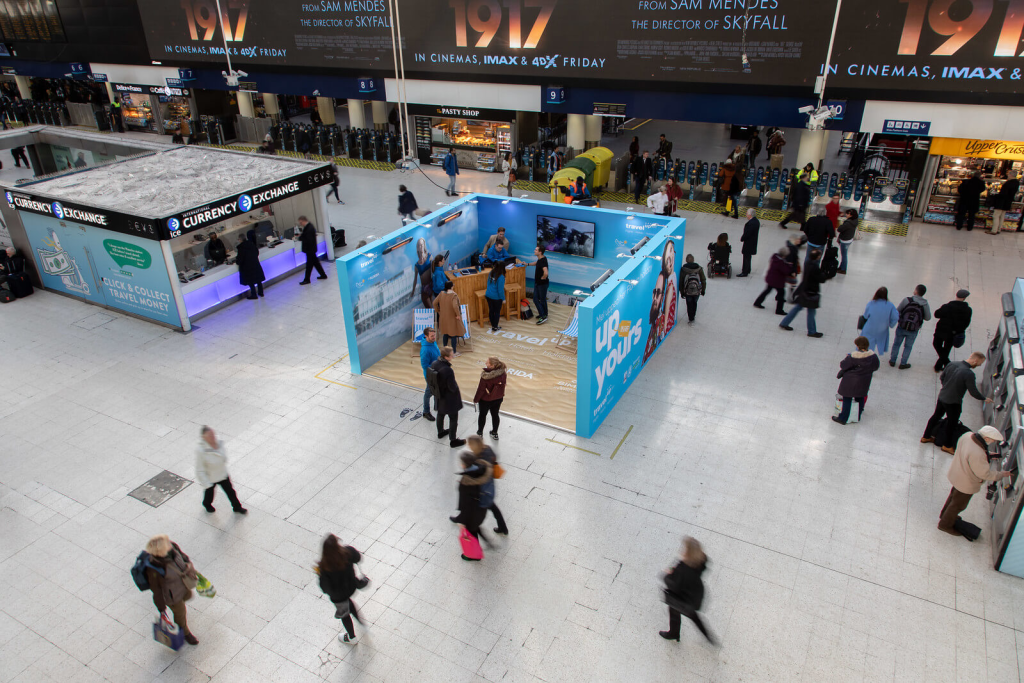
SEVEN delivered a brand activation for TravelUp and Visit Florida at Waterloo Station’s main concourse that captures this challenge well. The brief was to give London commuters a few minutes of genuine escape to Florida’s beaches in the middle of winter.
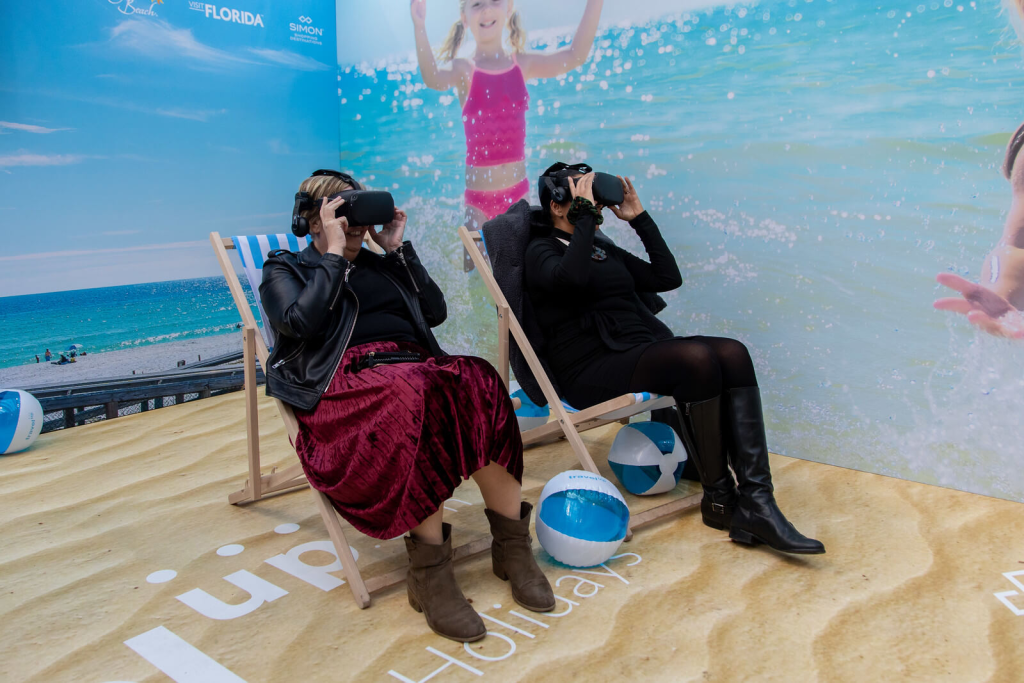
SEVEN sourced the concourse location and produced an immersive installation built around a VR experience, letting visitors take a guided journey through Florida’s highlights.
- Product launches use the exhibition format to give a new product or service its first public moment. The production quality has to match the ambition of what’s being launched, and the experience needs to give media, clients, or partners something to take away beyond a brochure.
- Experiential marketing installations are perhaps the most open-ended category. The brief is to create an environment that expresses a brand idea physically, often transforming a space that was never designed for the purpose.
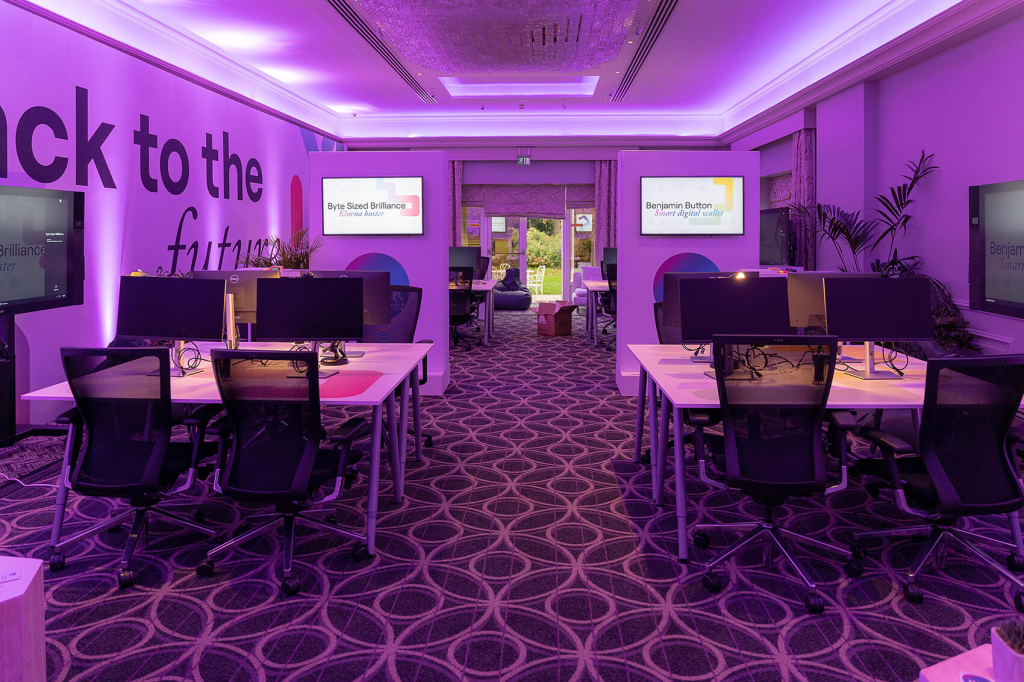
SEVEN’s work on a hackathon event for a technology client shows what this looks like in practice. The brief was to transform the conference spaces at Sopwell House into an immersive week-long workspace for eight teams of hackers.
Eight distinct hacking areas were created, each built for both productivity and creative thinking. The technology layer included personalised Surface Hubs for collaborative working.
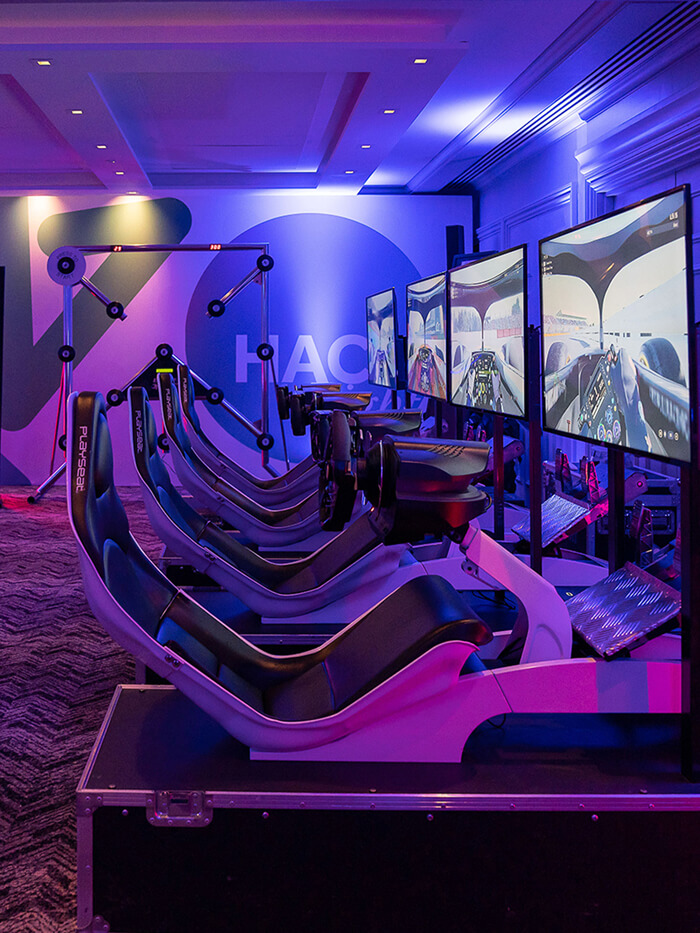
Alongside the physical build, SEVEN designed a programme of energiser activities and structured breaks, barista coffee, mobile massages, retro games, a pizza night, and wine tasting, that gave teams recovery time without breaking the event’s momentum.
Step-by-Step Exhibition Planning Process
Good exhibition stand design and production follow a clear sequence, and the order matters.
- Define your goals first. Are you there to generate leads, launch a product, raise brand awareness, or something else entirely? The answer shapes every decision that follows.
- Move into concept and design development. This is where the creative brief is translated into spatial thinking, layout, visual identity, interactive elements, and the overall visitor journey.
- Build the production plan. Technical specifications, supplier briefs, fabrication timelines, and venue logistics all need to be confirmed before the build phase begins.
- Manage the build and installation. This phase needs a dedicated project manager on the ground who knows the design, the technical spec, and the venue.
- Run on-site management throughout the event. A production team that disappears after installation is only half the service. The value of a professional event production agency in London is in having people present throughout who can resolve issues before they become problems.
- Review and report post-event. Footfall, engagement, lead volume, and conversion data all feed back into the brief for next time.
Common Exhibition Challenges
The same difficulties come up across almost every exhibition project when the planning hasn’t been thorough enough.
- Poor stand visibility is the most common. A stand that blends into its surroundings fails before a single conversation starts. Visibility is a design decision and doesn’t happen by accident.
- Weak engagement happens when the stand has been designed as a display rather than an experience. Visitors walk past, glance, and move on. The fix is interactive elements and a team with clear prompts for starting conversations.
- Technical failures during the event are almost always the result of inadequate testing before the doors open. An experienced event production agency in London will run full technical checks with enough time to resolve anything that needs attention.
- Budget overruns typically come from scope changes that weren’t flagged early, or from underestimating the complexity of the build. A good agency will flag risks and cost implications before they become surprises.
How to Maximise Exhibition ROI?
Every exhibition represents a significant investment. Getting value from it requires measurement that goes beyond a rough head count.
Track footfall through your stand separately from general visitor numbers. Measure how many conversations your team had and how many progressed to a genuine lead.
Follow up on those leads within 48 hours, because exhibition contacts go cold faster than most sales teams expect.
Beyond the immediate numbers, track brand recall, asking clients and prospects in the weeks after the show whether they remembered seeing you, and what they remembered. That data is more useful than it sounds when you’re briefing the design for next year.
For a closer look at how production and management work together across different event formats, read our guide on Event Production vs Event Management.
Why Work With an Event Production Agency in London?
A professional event production agency in London brings together the creative design, technical expertise, and project management disciplines that exhibition success depends on.
The agencies that do this well are the ones where those three things are genuinely integrated, not bolted together at the last minute.
SEVEN handles exhibition stand design and event production services as a single, joined-up offering. That means one team, one brief, and one point of accountability from concept through to the final pack-down.
Planning your next exhibition or brand activation? We’d love to talk through your brief.
Connect with the team at SEVEN
FAQs
1. What is exhibition stand design?
It’s the process of creating a branded physical space for an exhibition or trade show, covering layout, visual identity, interactive elements, and the visitor journey from arrival to conversion.
2. What does an event production agency do?
They handle the technical execution, logistics, and on-site delivery of events and exhibitions, including AV, lighting, fabrication, installation, and live event management.
3. How much does exhibition stand design cost?
Costs vary based on the size of the stand, the complexity of the build, the materials specified, and the level of technical production involved. A good agency will work transparently within your budget from the briefing stage.