How to Plan a Successful Product Launch Event
Plan a product launch event that helps your audience experience what’s new. This guide covers goals, format, venue, production, promotion and measuring results after the launch.
Plan a product launch event that helps your audience experience what’s new. This guide covers goals, format, venue, production, promotion and measuring results after the launch.
To plan a product launch event, define the audience and launch goal first.
Choose a format and venue that let people experience the product, build a clear production timeline, plan promotion and follow-up, and decide how success will be measured before the event begins.
A successful launch should give people more than a first look at a new product.
It should help them understand what it does, why it matters and how it fits into their lives or work.
The experience needs to connect the product’s value with the expectations of the people attending, while giving the business a clear way to evaluate the outcome.
At SEVEN, we bring creative thinking, audience insight and practical delivery together to help brands develop launch experiences around their objectives.
Here is how to approach the process, from the initial brief to post-event evaluation.
Set the launch objective and audience
Every launch needs a clear purpose. Before considering venues, entertainment or production ideas, establish what the business wants the event to achieve.
Without this direction, it is easy to spend time and budget on activities that look impressive but do not support the launch.
Start by identifying the main objective.
You might want to introduce a new product to potential customers, demonstrate a service to existing clients, generate media interest, support a sales team or bring business partners together.
Some launches have several objectives, but prioritising them helps determine where the event should focus.
Next, decide how you will recognise success. Depending on the launch, useful measures could include:
- Number of relevant attendees who register and attend.
- Product demonstrations, trials or samples completed.
- Questions, enquiries or requests for further information.
- Meetings arranged with prospective customers or partners.
- Feedback on product understanding and the overall experience.
- Media coverage or approved social content generated around the launch.
These measures should reflect the purpose of the event. Attendance alone, for example, will not tell you whether guests understood the product or are interested in taking the next step.
Understand what your audience needs to experience
Once the objective is clear, consider who needs to attend and what they need from the experience.
Customers may want to understand the product’s benefits, while journalists may need access to product information, spokespeople and demonstrations.
Employees and sales teams may need a more detailed introduction so they can communicate the product confidently.
Build an audience profile that considers their interests, familiarity with the product, expectations and practical requirements.
Think about the questions they are likely to ask and any concerns that the event should address.
SEVEN’s work with Just Eat for Business illustrates why this matters. The launch needed to introduce the service to corporate clients while also engaging internal sales teams.
These audiences needed to understand how the service could work in an office environment, so the experience was designed around practical demonstrations rather than a conventional presentation alone.
Choose the format, venue and experience
The format should make it easy for the audience to understand and interact with the product. A live launch may be suitable when people need to test, taste, handle or see the product working.
A virtual event may be more practical for a geographically dispersed audience, while a hybrid format can combine a live experience with remote access.
Consider the nature of the product before deciding. A technology launch may benefit from guided demonstrations and opportunities to ask technical questions.
A food or beverage launch could include sampling, while a new business service may need realistic scenarios showing how customers would use it.
The important point is to choose a format that supports the product story rather than selecting one simply because it is popular.
Select a venue that supports the product experience
The venue should accommodate the audience, programme and practical requirements of the launch.
Consider its location, capacity, accessibility, layout, technical facilities and suitability for demonstrations.
Think beyond the room itself. Will guests have enough space to interact with the product?
Can the venue support staging, screens, demonstration areas and catering without interrupting the guest journey?
Are there suitable spaces for media interviews, private conversations or networking?
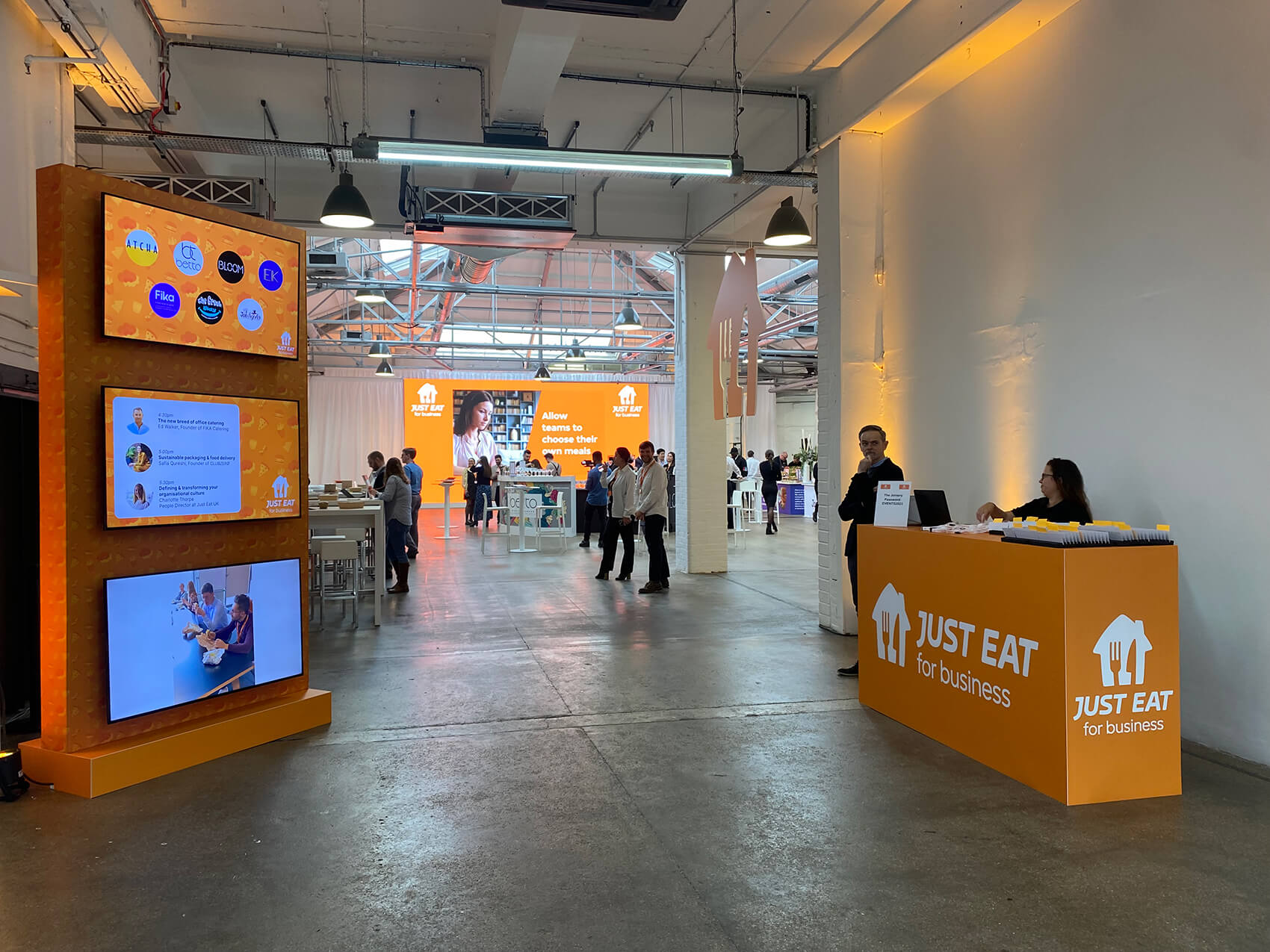
For the Just Eat for Business launch, SEVEN sourced a blank-canvas venue in Shoreditch and transformed it into a working office environment.
The setting included ordering demonstrations, packaging props and lounge seating.
This allowed guests to visualise how the service could fit into their everyday working environment.
Design an experience that makes the product easy to understand
The product should remain at the centre of the experience. Every creative decision, from the entrance and signage to the demonstrations and stage content, should help communicate its purpose or value.
For the Just Eat for Business launch, the event was named ‘Just Meet for Business’.
Branded vinyls and digital totems welcomed guests, while interactive ordering stations and food vendor stalls demonstrated the platform in action.
Five vendor stands offered food for guests to try, and a central circular bar encouraged conversation.
This approach made the product tangible. Guests could explore the service through an environment that reflected how it would be used, rather than relying only on slides or verbal explanations.
SEVEN’s experiential and creative design service brings together concept development, spatial design and production to shape how people experience a brand or product.
The aim is to make the creative idea relevant to the audience and practical to deliver.
Build the event plan and promotion timeline
Once the objective, audience and format are agreed, turn the concept into a detailed delivery plan.
This should cover responsibilities, deadlines, suppliers, production requirements, communications and approvals.
A useful plan gives everyone involved a clear understanding of what needs to happen, who owns each task and when decisions are required.
Create a realistic planning timeline
The time required will depend on the event’s size, complexity, venue and production needs.
A smaller launch with a straightforward format may need less preparation than a multi-location event with custom-built installations, several suppliers and a large guest list.
The following is an illustrative timeline for a corporate launch. Adjust it to suit the actual brief rather than treating it as a fixed rule.
| Planning stage | Key decisions and actions | Main owner | Expected output |
| Initial planning | Agree objectives, audience, budget and success measures. | Client and event lead | Approved event brief |
| Concept development | Select the format, venue direction and creative approach. | Creative and event teams | Concept and initial proposal |
| Supplier and production planning | Confirm venue, technical requirements, suppliers and logistics. | Production and project teams | Delivery plan and budget |
| Guest communications | Prepare invitations, registration and pre-event information. | Client and communications teams | Guest communication schedule |
| Final preparation | Confirm timings, speakers, demonstrations and contingency arrangements. | Event lead and suppliers | Final running order |
| Event delivery | Coordinate setup, guest arrival, programme and on-site activity. | On-site event team | Delivered event |
| Post-event review | Gather feedback, review agreed measures and share follow-up content. | Client and event team | Evaluation and follow-up report |
Coordinate production, suppliers and responsibilities
Production involves more than arranging screens, lighting and sound. It connects the creative concept with the practical requirements of delivering the experience safely and consistently.
For a launch involving demonstrations, consider equipment, power, connectivity, product handling, technical rehearsals and backup arrangements.
Confirm who is responsible for transporting, installing and testing each element. Speakers and presenters should also know when they need to arrive, what technical support is available and how their contributions fit into the running order.
A product launch event production plan should include a detailed schedule for venue access, supplier arrivals, installation, rehearsals, guest registration, programme timings and breakdown.
It should also identify the person responsible for making decisions on site.
When comparing external support, look at the team’s relevant experience and how it manages suppliers, changes and delivery.
Our guide to choosing event organisers in London explains the questions businesses can ask when assessing an event partner.
A creative production agency should be able to explain how its creative ideas translate into the space, technical setup and guest experience.
Ask to see examples of comparable work and clarify which elements the team will design, source, manage and deliver.
Build anticipation before the launch
Promotion should help the right people understand why they should attend. Start with a clear message about what is being introduced and why it is relevant to the audience.
Depending on the launch, pre-event activity could include personalised invitations, teaser content, speaker announcements, product previews and targeted communications to customers or media contacts.
Make registration straightforward and provide practical information such as timings, location, access arrangements and what guests can expect.
For the Just Eat for Business launch, branded window vinyls, digital totems and animated content helped establish the event identity before guests entered the venue.
These elements supported the wider experience and introduced the brand message early.
Measure results and follow up
The work does not finish when the last guest leaves. A post-event review helps you understand whether the launch achieved its objectives and what should happen next.
Start by collecting information while the experience is still fresh. This could include attendance figures, demonstration participation, questions, feedback forms, media coverage and enquiries.
Compare these results with the measures agreed during the initial planning stage. Avoid relying on one metric to judge the entire event.
A launch designed to educate existing customers may be assessed through product understanding and follow-up conversations.
At the same time, one aimed at generating sales opportunities may focus on qualified enquiries and meetings.
Continue the conversation after the event
Follow-up should be relevant to the audience and the next step you want them to take.
Send a thank-you message, share approved photographs or highlights, and provide product information that helps guests revisit what they experienced.
For prospective customers, this might include a product demonstration link, brochure or invitation to arrange a conversation.
Media contacts may need approved images, product details or access to a spokesperson. Internal teams may benefit from presentation materials and key messages they can use in future conversations.
For the Just Eat for Business launch, SEVEN supported the experience through its creative concept, venue transformation, branded environment, interactive demonstrations and on-site delivery.
The original article also records positive client feedback about bringing the event to life.
Any additional testimonial, performance figure or commercial outcome should only be included where the client has approved the wording and supporting evidence.
Finally, review what worked and what could be improved. Record feedback from the client, attendees and delivery team while the details are clear.
These insights can help shape future launches and make subsequent planning more informed.
FAQs
1. How do you plan a product launch event?
Focus on how the audience will understand and experience the specific product.
Identify its key benefits and proof points, then choose demonstrations, samples or interactive activities that bring those points to life.
Make sure the venue, event story, production and communications support the same message.
2. What is a product launch event?
A product launch event introduces a new product or service to a selected audience.
It may involve presentations, demonstrations, sampling, media activity or networking, depending on the product and business objectives.
It is one part of the wider go-to-market campaign, which can also include advertising, sales activity and ongoing customer communications.
3. Which agencies specialise in corporate product launches in London?
Look for agencies with relevant corporate launch experience, a clear portfolio and the production capability to deliver your chosen format.
Ask what each team was responsible for, how it manages suppliers and who will lead the project on site.
Compare the proposed approach, budget and responsibilities against your brief rather than relying on general claims about expertise.
Bring your product story to life with SEVEN
A successful launch connects a clear business objective with an experience that helps people understand the product.
Careful planning, relevant creative thinking and coordinated delivery allow each part of the event to support that purpose.
At SEVEN, we bring strategy, creative design, production and event management together to help brands shape launches around their audiences.
From the initial brief to the live experience and post-event follow-up, our team can support the requirements agreed for your project.
Planning a launch for your business? Speak to SEVEN about your objectives and the experience you want to create.